
Bad beginnings: solving roguelikes’ early game issues
Games like Balatro, The Binding of Isaac, and Slay the Spire start slowly. Too slowly.

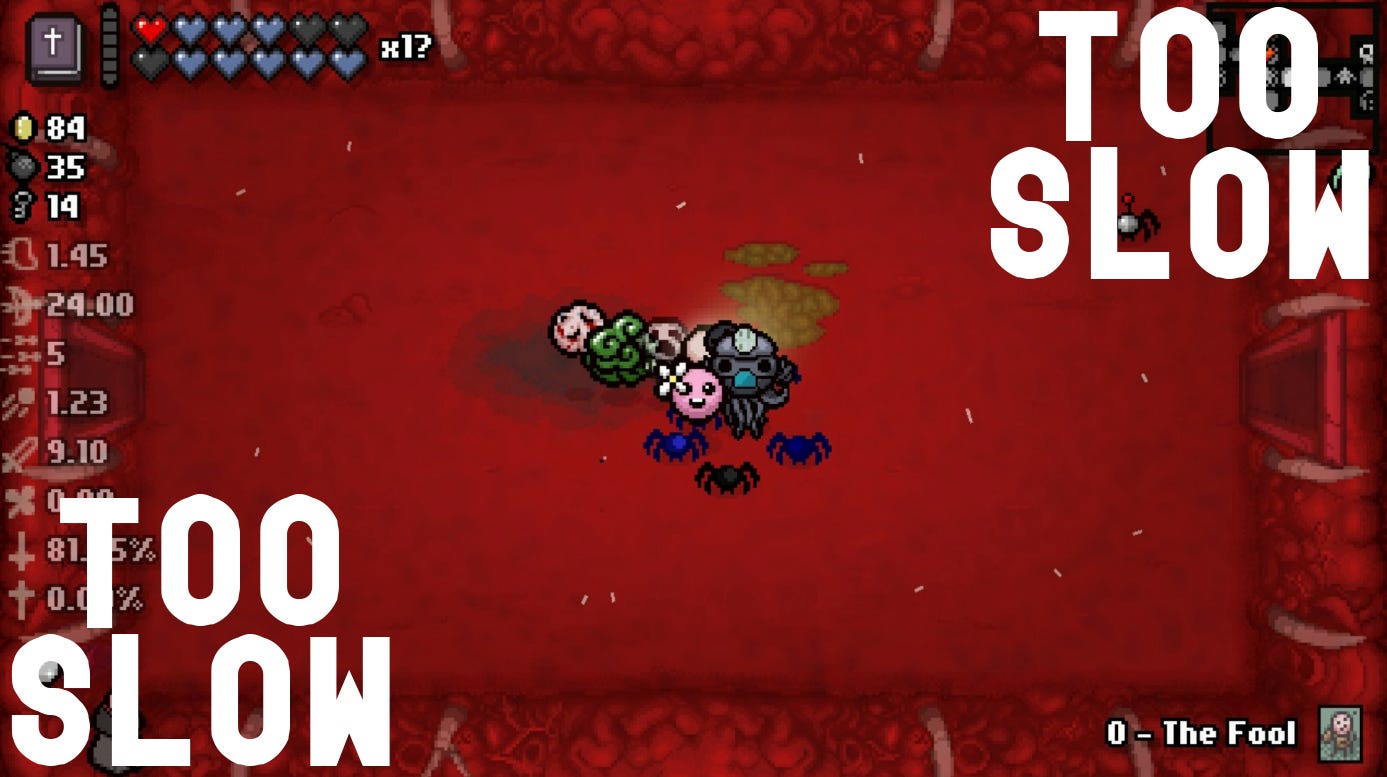
I have a screenshot on my Switch, grabbed at the culmination of a Binding of Isaac run. Look, there it is above, with the text ‘too slow’ thrown on. The player character is barely recognisable any more – as a human, let alone as the helpless naked baby he was at the beginning of the run.
By the time I’d seen the ending, Isaac had been transfigured into a mishmash of cosmic and religious horror creatures, surrounded by familiars mundane and chthonic. I could clear every trial without trying, because each new power I had acquired fed off and into the others, amplifying them to the point that nothing could stand in my way.
Then I hit retry, and got dropped back into the starting room with base stats. And it was dull. I think that might have been my last real run at the game.
‘Roguelike’ is a very broad term for a game that takes inspiration from the 1980 adventure title Rogue. While there are very many criteria that can qualify a game as a roguelike, the two most common are an element of procedural generation, and permadeath that forces a player to start over from the very beginning upon failure. There are tons of subgenres by this point, with card-based deckbuilders or shooters, but those are the main points of comparison between roguelikes.
Then we have ‘rogue-lites’, which usually allow you to keep some progression between runs. But for the purposes of this article we’re looking at the genre in the round.
The goal is usually to reach an end state, or to defeat a final boss. You typically start with a base character or deck that, through exploration or progression, becomes more powerful as you acquire new abilities.
As with my Binding of Isaac run, if the procedural generation gods lend you their favour, you can end up as an unstoppable force that breaks the game wide open.
But you will always start as a weak, helpless, mewling little thing with the worst movement and combat abilities. Sometimes, as with Isaac, that means you’ll begin to consider the early game a chore to get through, because your options are just that limited.
Slow and too steady
For as much as I like Slay the Spire, the progression to the first boss feels rote and predictable, an obligation like making conversation with your aunt’s friend at a family wedding when you’d much rather be tanking some whisky with the cousins. Even alternative base characters like the Defect only alter the formula so much. Black Jacket, which I’d otherwise really recommend as a blackjack based deckbuilder with an interesting story, forces you to go through the same first round each time, until it feels more like punishment than incitement to continue.
Perhaps the worst recent example of this early game issue can be found in Balatro. This poker based deckbuilder is deservedly incredibly popular, and until a few months ago I would pour hours into it on any given week.
Eventually, the all-too-slow progression of the first few antes begins to grind. No matter the base deck, or the initial difficulty, you’ll be searching out the same hands ad nauseum until you’ve acquired enough Jokers to make strategising a possibility again. These aren’t even all necessarily the fault of the games: it can be a problem with overfamiliarity. I really did play Balatro far too much; if I’d rationed it out then perhaps I’d still love hunting down them flushes.
It’s also undeniable that starting from so weak a position is absolutely paramount for the success of games in the genre. You can’t be too powerful to begin; it sets a baseline for later challenges, and establishes the parameters and rules that you’ll eventually alter or break.
Some roguelike games, through, make that early game fun despite those constraints.
And… action
Part of Binding of Isaac’s appeal is in how fundamentally its rules can be broken.
At the very start of a run your character can only shoot lone projectiles in the four cardinal directions, while by the end you’ll be performing a dervish, firing toxic blood tornadoes while you skitter round the outskirts of the map over pits no enemy could hope to follow you across.
But at the start you will plod.
Other action roguelikes alleviate this by making even the very first stage a test of your dexterity, combat, and exploration capabilities. While Enter the Gungeon does this excellently, making even the earliest stages of a run fun to play, Hades sets the gold standard.
Zagreus and Hades II’s Melinoë are agile, lethal combatants from the off, and your movement options do not feel limited in the way slower roguelikes’ often do. Moreover, because the games have a hub in which you can (or have to, even) spend time prior to launching a new run, there is a sense of downtime between tries that alleviates a lot of the overfamiliarity of Isaac. Its story and developed characters, too, provide a narrative reason to launch your next attempt beyond simply wanting to see the credits.
Dead Cells, too, manages to make the most of its Castlevania-inspired exploration to ensure you’re always keen to see what’s round the next corner, even while you’re oh-so-very weak to begin with.
Crypt of the Necrodancer and its Zelda-flavoured sequel Cadence of Hyrule also manage to make the core gameplay feel interesting from the start. Its rhythm based movement and combat aren’t just there for the gimmick; the mechanic adds spice to that early game.
It also cleverly reinforces the main concept of the story – your character’s heart has been stolen, so each eighth note is one half of the heartbeat you seek to reclaim.
Breaking the rules
There are a few roguelikes that really lean into the interplay between mechanics and story. These games acknowledge that the base rules of a roguelike are, in a sense, arbitrary – and then ask who made them that way?
And, these games whisper, if the rules are so arbitrary, why shouldn’t you break them?
Black Jacket, for its early game issues, does this excellently. Your character Kris (excellent name, by the way) is trying to play his gamble out of Hell. Along the way, in addition to playing blackjack against generic lost souls, you encounter four bosses, each of which has some connection to your amnesiac protagonist. If you can beat them, you recover more of your memories, and uncover these bosses’ stories in turn. It’s both a nice narrative draw – but trading your victory for one of their trinkets empowers your character on the next run. The rules – such as they are – are broken as you begin to realise they have been self-imposed by a guilt-ridden sinner seeking to punish himself.
Maybe the single best example of ludonarrative (I avoided using this word for as long as I could, I promise) harmony in a roguelite comes from Inscryption. More impressively, it manages to do so in a way that means the early game isn’t a slog at all.
I’ve written before about how Inscryption doesn’t hide the fact it has a metanarrative. As part of that conceit, your opponent outright acknowledges it has set those base rules for you. And, as you’ll learn early on, it feels it has the right to cheat in order to beat you. You will, very early on, run up against a brick wall of a thousand bears being played against you, and the game in no way pretends this is fair.
What it does do, though, is encourage you to cheat in turn. So, in game, you push away from the table on which this rigged game is being played, to explore the environment around you. In doing so you’ll need to solve puzzles to find new cards to play, and to gradually find ways to stack the deck in your favour.
It is a wonderful way to break up the early game monotony of a deckbuilder; in fact, you could argue that it plays with the form so effectively it isn’t truly a roguelike at all (its expansion Kaycee’s Mod absolutely is, mind).
Checks and balances
I can’t imagine how hard it is to make a roguelike.
Even with the slightly looser approach to game balance that the genre allows for, there has to be an appropriate level of challenge. Yes, you might end up a God absolutely breezing round, through, or over the levels as a result of a good spate of RNG, but you have to feel like you earned it by surviving early on.
So it’s very hard for me to fault even the games I mentioned at the top for making their starting areas or rounds too plain. You have to let new players learn the ropes, for one thing, and that would be hard if you frontload too many gamebreaking abilities.
And for all I raved about that one build I had in Isaac, destroying the final boss wasn’t as cathartic as it could have been either.
All of which is to say, roguelike games are a perennial favourite among gamers for a reason. They can be, if you are sufficiently skilled or lucky, a power fantasy. But to appreciate the view from the top, you have to have crawled along the bottom to begin with.
The joy of decks: why deckbuilders make us happy

There are countless memes dedicated to the feeling you get when the scissors start to glide. The silken smoothness of the movement – the reward for those first few tricky, manual snips into the wrapping paper – is a universal joy.