
The code archaeologists: discovering the secrets buried in games
These dedicated experts unearth dev secrets, buried levels, and abandoned stories in the games we love

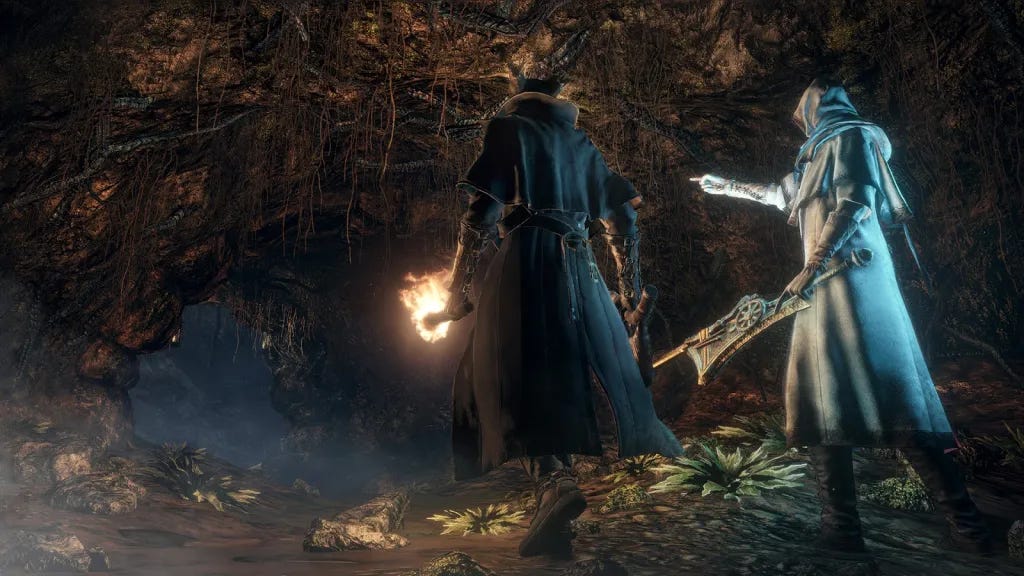
When Bloodborne was released in 2015, its players were faced with a startling discovery around halfway through its narrative. What had initially appeared to be a gothic horror title was no such thing. Oh no, somewhere around the occult college Byrgenwerth we were confronted with something far more… cosmic.
Bloodborne isn’t gothic horror, not really. It’s Lovecraft-flavoured cosmic horror. Behold, Ebrietas, Daughter of the Cosmos, and let the madness take you.
Over the course of the game’s optional Chalice Dungeons, we learn that the city in which we spent the opening hours was built upon the ruins of another civilisation, one that had lost itself to the obsession with the Old Ones, unknowable alien gods. That civilisation, in turn, was built upon another crumbling kingdom, and that upon another. By delving into the depths of the world, as archeologists and explorers, we discover the truth of our reality.
But a dummied-out voice line for the character Father Gascoigne, found in a network test version of the game, suggested something else was afoot. Something more fundamental. Because Gascoigne originally echoed the closing prayer of a character from FromSoftware’s earlier title Demon’s Souls — suggesting that Bloodborne was at one point considered to be a stealth sequel.
Layers upon layers of discovery in-game. And many thousands more layers and secrets buried in the code besides.
Buried treasure
There are many YouTubers who specialise in digging for secrets in various games’ code, and I’m never less than wildly impressed by their ability to do so.
Some, like Boundary Break’s Sheshez, manipulate the game’s camera to spot the easter eggs and development shortcuts hidden throughout the game space. Others, like King Bore, examine oddities and anomalies in levels, and pair that with community speculation to discover that, among other things, the notorious Lost Izalith in Dark Souls was originally a swamp instead of a lethal lava land.
Others, like my two favourites Illusory Wall and Zullie the Witch, will examine a game’s code almost holistically, to discover entirely scrapped bosses, mechanics, and levels. I think they’d be the first to point out it is a collaborative effort, but part of discovery is how you present those findings, and I believe these two to be the best of the best at doing so.
Take a look at this short-form video from Zullie, for example. It examines the Omenkillers, recurring minibosses throughout Elden Ring. Zullie noticed that, despite them not having tails in the game, their model skeleton implied they did. From there, Zullie worked out they were largely based on the Capra demons of the first Dark Souls – but also noted that the tail was taken into account for some new animations.
It’s a discovery that sheds light on the development process of the much-loved game. But watch how Zullie uses that discovery to also elucidate on some of the final lore. We learn the Omen are internally labelled ‘Shunned Child’, suggesting their place in the cosmology was fixed early, and therefore bedrock to the story. But Zullie takes the presentation to another level, manipulating models to illustrate how the Omenkillers were modelled after monsters Omen saw in their dreams. It’s beyond simple presentation; it’s the direction and production of a short movie.
Or take a look at this video from Illusory Wall. It’s been well-known that the production of Dark Souls II was very troubled; it might be the best-known thing about it, even.
But other than scraps we heard about an abandoned time travel element, or the enigmatic viaduct that would have connected many areas in a way we don’t see in the final version, it’s hard to know what was changed – or, perhaps, lost.
Illusory Walls’ ‘How the Gutter got Gutted’ shows us exactly what we could have had. The Gutter is mostly a black expanse of scaffolding and planks in the final game. But, as he sets out by examining an old version of the map, it was once so much more. It had houses, pubs, a dragon skeleton, even statues of the king and queen. While he – rightly – points out that games change throughout development and these changes don’t necessarily make a game worse, this video is a tantalising look into a title that promised so, so much more than it ultimately delivered.
I still love you, Dark Souls II. You’re my joint favourite in the series, along with your big brother DS1. And all these explorations of your code only make me love you more.
It’s this sort of activity that reframes how we think about how a game’s story evolves over development. By datamining Bloodborne further, for example, it was discovered that Ebrietas was originally named Kos, a separate figure in the final game. That discovery reframed everything about the character, fuelling speculation as to what the original intention for her character was.
And, at the very bottom of Bloodborne’s Chalice Dungeons, a dummied-out location that looked suspiciously like where we find the Old One at the conclusion of Demon’s Souls was eventually unearthed. Layers upon layers.
Love of the game
It takes a very particular set of skills to undertake this sort of digital archaeology.
You have to be tech-savvy, almost unbelievably so. For some thing, some game engines are proprietary, meaning that these fans have to effectively reverse engineer nested, interdependent systems, and either discover the debug options or mod in free camera options. It takes perseverance; these code bases are often tangled messes, or confusingly labelled. And, for those who look for hidden secrets and discoveries, it takes knowledge of both the final product and likely earlier versions of the same.
So, what is the appeal? Why do I enjoy watching these people tear apart code, discovering the what-ifs and could-have-beens of my favourite games?
In part, it’s because of the personalities of the people who do it. There’s nothing quite so satisfying as watching someone who is an enthusiastic expert elucidate on a topic.
Maybe a few things, actually, but it’s up there.
For another, games are unique among media in that they are created mostly by teams, all working at once, collaborating to deliver upon a singular vision. When that vision changes, imprints and shadows of the previous versions remain. Some code might refer to a removed character, or weapon, or story beat, remaining there like a phantom limb.
Unlike the finished products of books or movies (mostly), those traces are discoverable in the final title. Sometimes, like Dark Souls II’s Gutter, or the physical Triforce accessible in earlier versions of Ocarina of Time, we spot the forking path to an alternate present. It lets us speculate on what might have been, informs us about the reality of the games we love as they are, and allows us to think about how something that was removed might return in another guise in the future.
If you have any interest at all in games as art, or just the sheer technical detail of their creation, I’d urge you to check out any and all of the channels I mentioned above. Let them be your guide through the detritus and ruins of game development – so you can discover a newfound appreciation for the games we do have.
If you’ve enjoyed this paean to some of my favourite YouTubers, please do follow them! Follow me first though, that’s very important. This newsletter is a labour of love, and I’d love it to grow so I can share my love of gaming with others.
I did not know that about Bloodborne!